
 Photo: Fernando · CC BY-SA 4.0
Sierra de Aracena & Roman Mérida
Turn north-west through Itálica and Aracena to Mérida, then return via Zafra on a four-day history-and-sierra loop.
- Allow
- 4 days
- Route
- 461 km
- Drive time
- 5 hr 31 min
- Stops
- 6
This is the Seville route for travelers who have already looked south. Roman Itálica begins almost in the suburbs; the Sierra de Aracena brings chestnut and cork-oak country, cave chambers and jamón culture; Mérida assembles the peninsula’s great Roman monuments into one walkable city.
Distances remain manageable, but rural meal times and monument schedules shape the days. Visit production towns respectfully, book any dehesa or food experience and keep the route out of the hottest summer weeks.
The road, in one glance
Pinch or scroll with Ctrl / ⌘ to zoom
Drawing the route…
The route earns
its distance
Each pin is selected as a place to do something—not merely proof that you passed through.
 Photo: Ingo Mehling · CC BY-SA 4.0
Seville
Point north-west after breakfast, keeping the first day for Roman Itálica and the sierra.
Seville is the capital and largest city of the Spanish autonomous community of Andalusia and the province of Seville. It is situated on the lower reaches of the River Guadalquivir, in the southwest of the Iberian Peninsula. Seville has a municipal population of about 686,741 as of 2024, and a metropolitan population of about 1.5 million, making it the largest city in Andalusia and the 5th-largest city in Spain.
 Photo: Diego Delso · CC BY-SA 4.0
Itálica
An amphitheatre, mosaics and gridded Roman streets survive just outside modern Santiponce.
Italica (Spanish: Itálica) was an ancient Roman city in Hispania; its site is close to the town of Santiponce in the province of Seville, Spain. It was founded in 206 BC by Roman general Scipio as a colonia for his Italic veterans and named after them. Italica later grew attracting new migrants from the Italian peninsula and also with the children of Roman soldiers and native women.
 Photo: Phillip Capper · CC BY 2.0
Aracena
A hilltop castle and the Gruta de las Maravillas anchor a lively small town in chestnut country.
Aracena is a town and municipality located in the province of Huelva, southwestern Spain. According to the 2025 municipal register, the city has a population of 8,425 inhabitants. The town derived its name from the Sierra de Aracena, which is part of the Sierra Morena system.
 Photo: Paulo Valdivieso from Lisboa, Portugal · CC BY-SA 2.0
Jerez de los Caballeros
Baroque towers rise above a white Extremaduran town with Templar associations and dehesa surroundings.
Jerez de los Caballeros (Spanish: ) is a town of south-western Spain, in the province of Badajoz. It is located on two hills overlooking the River Ardila, a tributary of the Guadiana, 18 km east of the Portuguese border. The old town is surrounded by a Moorish wall with six gates.
Photo: Fernando · CC BY-SA 4.0Mérida
The theatre, amphitheatre, bridge and museum make Spain’s Roman capital a full-day stop.
Mérida (Spanish: ) is a city and municipality of Spain, part of the Province of Badajoz, and capital of the autonomous community of Extremadura. Located in the western-central part of the Iberian Peninsula at 217 metres above sea level, the city is crossed by the Guadiana and Albarregas rivers. The population was 60,119 in 2017.
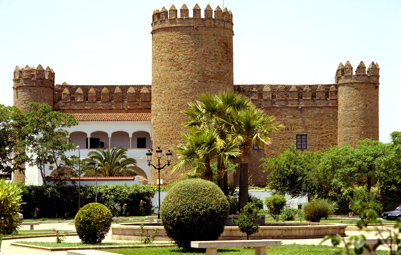 Photo: Pederseguro · Public domain
Zafra
Arcaded plazas and a former ducal palace provide a graceful final overnight on the route south.
Zafra (Spanish:; Extremaduran: Çafra) is a town in the Province of Badajoz (Extremadura, Spain), and the capital of the comarca of Zafra - Río Bodión. It has a population of 16,677, according to the 2011 census. Zafra is the hometown of Fray Ruy Lopez, author of one of the first European treatises on chess, and the humanist Pedro de Valencia.
Drive the conditions,
not the itinerary.
Carry fuel margin in the sierra, watch for livestock and use formal town parking. Cross-regional monument hours vary.
Checked against
the people who run it
Distances and driving times are planning estimates. Conditions, closures, ferries, permits and park rules can change, so check the linked official guidance before setting out.