
Feria de Abril Guide
Everything a first-timer needs to understand Seville's April Fair: when it falls, what the fairground and the casetas are, the private-caseta system and how to get inside the fun, the daytime horse paseo and the lantern-lit nights, what to wear, what to eat and drink, where to stay, and how to fit the city around the fair.

Photo: Eugenia Pan'kiv / Unsplash
- ✓Feria de Abril usually falls about two weeks after Easter, so the dates move every year — and despite the name it can spill into early May. Confirm the exact dates before booking.
- ✓The fair builds a temporary town — the Real de la Feria — across the river in Los Remedios: a grid of striped marquees (casetas) under thousands of paper lanterns, entered through a giant illuminated gateway (the portada) redesigned each year.
- ✓The crucial thing to know: most casetas are private, belonging to families, clubs and companies. Getting inside the fun depends on an invitation, a public caseta, or an organised experience.
- ✓There are two Ferias in a day — the elegant daytime horse-and-carriage paseo and the long, loud, dancing night — and they feel completely different.
- ✓Dressing up (the traje de flamenca for women) is optional but joyful; rebujito and fried fish fuel the long nights. Book accommodation months ahead.
What the Feria is
Feria de Abril — the April Fair — is Seville's great explosion of joy, the exuberant counterweight to the solemnity of Semana Santa a couple of weeks before. For roughly a week, the city builds a temporary town across the river in the Los Remedios district: the Real de la Feria, a grid of streets lined with hundreds of casetas — striped canvas marquees — strung overhead with thousands of paper lanterns (farolillos) and entered through a vast, illuminated gateway called the portada that is redesigned to a new theme every year. Inside the casetas and out in the lanes there is dancing, sherry, food, music, horses and celebration from afternoon until deep into the night, every single day of the fair.
The fair has its own folk dance, the sevillanas, danced everywhere once the music starts; its own drink, the refreshing rebujito; and its own dress, the flounced traje de flamenca. It traditionally opens with the alumbrao, a hugely anticipated Monday-midnight switching-on of the portada's lights, and runs through the following week. Where Semana Santa turns the city inward in reverence, Feria turns it loose in pure, collective happiness — and to be there for even a single night is to glimpse the soul of Seville.
When it happens
Like Semana Santa, the Feria has no fixed date. It falls roughly two weeks after Easter Sunday, which means it usually lands in late April — but in years when Easter is late it can slip into early May, making the name a little misleading. The fair runs for about a week, traditionally from the Monday-midnight alumbrao through to the following Sunday, when it closes with a fireworks display over the river. (For a few years up to 2024 the fair experimented with a Saturday-night opening, but Seville restored the traditional Monday-midnight alumbrao from 2025 — one more reason to check the official calendar for your year.)
Because the dates move every year, the first rule of planning a Feria trip is to look up the exact days for your travel year before you book anything. Be aware, too, that the Feria comes hard on the heels of Semana Santa: if you hope to catch both in one trip, you are looking at a fortnight or more in the region, with the two festivals occupying very different emotional registers. As ever, confirm dates and any published fairground arrangements on official city sources, and check closer to the trip for the specifics.
- Falls roughly two weeks after Easter — usually late April, occasionally early May.
- Runs about a week, from the Monday-midnight alumbrao to the closing Sunday fireworks.
- Dates move every year — confirm them before booking, and verify on official sources.
- It follows Semana Santa closely; catching both means a fortnight-plus in the region.
The fairground and the casetas
The Real de la Feria is laid out like a real town, with named streets, lighting and the great portada at its entrance, all built fresh each year and dismantled after. The lanes are lined with casetas — the striped marquees that are the heart of the fair. Inside, a caseta is essentially a private bar-and-dancefloor: tables, a counter serving drinks and food, room to dance the sevillanas, and walls hung with decoration. At the far end of the fairground lies the funfair, known as the Calle del Infierno, blazing with rides and games for anyone with energy to spare.
Now the single most important thing to understand, the fact that catches almost every first-timer out: the vast majority of casetas are private. They belong to families, groups of friends, social clubs, trade associations, political parties and companies, and you cannot simply walk into them — entry is by invitation or membership. Visitors who picture themselves wandering the fairground dropping into tents at will are often dismayed to find row upon row of closed, members-only marquees. The fair is glorious, but its structure is exclusive by design, and going in aware of that is the difference between disappointment and a great time.
- The Real is a temporary town built fresh each year: named streets, the portada gateway and the funfair (Calle del Infierno) at the far end.
- A caseta is a private marquee with a bar, food, decoration and a dancefloor for the sevillanas.
- Crucially, most casetas are private — entry by invitation or membership only.
- Do not expect to wander in freely; understanding the caseta system is the key to a good Feria.
Getting inside the fun
Since most casetas are private, the central question of a Feria trip is how you will experience the fair from the inside rather than from the street. There are a few honest routes in. The best is an invitation: if you know a local, a friend of a friend, or anyone connected to a club or company with a caseta, that invitation is the golden ticket — Sevillanos are warmly hospitable to invited guests, and being welcomed into a private caseta is the quintessential Feria experience. Failing a personal connection, look for the public casetas: a number are open to anyone, typically run by the city, districts, unions or political parties, where unconnected visitors can step inside, buy a drink and a plate of food, and watch or join the dancing. They are busier and less intimate than a private caseta, but they are genuinely fun and they are open to you.
A third route is an organised Feria experience or tour, which some local operators run; these can include access to a caseta and a guide to explain what you are seeing, and for a visitor with no local connections they can be the difference between watching the fair and being part of it — verify exactly what any such tour includes before booking. And if none of these come together, do not despair: the open lanes of the Real are a spectacle in themselves, full of strolling crowds in their finery, music, horses and food stalls, and the funfair is open to all. You can have a wonderful time simply walking the fairground and soaking it up.
- An invitation from a local with a private caseta is the best way in — and the warmest experience.
- Public casetas (city, district, union, party) are open to everyone: livelier, busier, the realistic option for visitors.
- Organised Feria experiences may include caseta access and a guide — verify what's included before booking.
- Even with no caseta access, the open lanes and funfair are a free, dazzling spectacle.
The two faces of the fair: day and night
The Feria has two distinct lives in a single day, and a good visit samples both. The daytime fair, broadly from around midday through the afternoon, is the elegant one: the hour of the paseo de caballos, the parade of horses and carriages, when riders in traditional short jackets and wide-brimmed hats — often with a woman in flamenca dress riding side-saddle behind them — and beautifully turned-out horse-drawn carriages process slowly through the broad central avenues. It is graceful, photogenic and almost aristocratic, bathed in spring light, and it is when families lunch in the casetas and the whole scene feels at its most decorous.
Then, as dusk falls and the thousands of farolillos are lit, the fair transforms. The night-time Feria is the loud, joyful, dancing one, and it runs until the small hours every single night. The casetas fill, the sevillanas strike up, the rebujito flows, and the whole Real becomes a swirl of music, movement and light. A night at the fair is a marathon, not a sprint: dinner happens late and stretches on, the dancing builds through the night, and the energy does not flag until dawn approaches. Pace yourself, eat as you drink, and accept that a real Feria night is a late one.
- Daytime (from midday): the elegant paseo de caballos — horses and carriages, families lunching, spring light.
- Night (from the lighting of the lanterns): loud, joyful, dancing, until the small hours, every day of the fair.
- A Feria night is a marathon — dine late, pace your rebujito, and prepare to stay out until dawn.
- The horse parade typically clears by early evening, so time your visit if the horses are what you want to see.

What to wear, eat and drink
Feria is the one time of year when dressing up genuinely adds to the experience. Many Sevillanas wear the traje de flamenca — the flounced, polka-dotted flamenco dress, the only regional costume in Spain that follows fashion and changes a little each year — and men often dress smartly or in traditional style. You are under no obligation to dress up to enjoy the fair, and plenty of visitors do not, but embracing it even a little (a flower in the hair, a smarter outfit) makes you feel part of the occasion, and locals respond warmly to the effort. Full trajes can be bought or sometimes rented in the city, though good ones are an investment — verify costs and availability locally.
On food and drink: the fair's signature drink is rebujito, chilled dry sherry (a manzanilla or fino) mixed with lemon-lime soda, served by the jug and poured into small cups, refreshing and dangerously easy on a warm afternoon — pace it, because it adds up faster than you think. The food is classic Andalusian fare built for grazing through hours of dancing: fried fish (pescaíto frito is so tied to the fair that the opening is sometimes called the noche del pescaíto), jamón and cheese, tortilla, croquetas, olives and tapas. Eating little and often across the night, rather than one big meal, suits the fair's rhythm perfectly — and lining your stomach properly is the secret to lasting until dawn.
- Optional but lovely: the traje de flamenca for women, smart traditional dress for men — embracing it makes you part of the day.
- Drink rebujito (sherry with lemon-lime soda) by the jug — refreshing but deceptively strong, so go gently.
- Eat the classic fair fare little and often: fried fish, jamón, cheese, tortilla, croquetas and tapas.
- The opening is sometimes called the noche del pescaíto, for the fried fish traditionally eaten that night.
Etiquette and behaviour
The Feria is welcoming but it has its codes. A private caseta is essentially someone's hospitality, so never push into one uninvited or hover at the doorway hoping to be waved in — it is awkward and unwelcome. If you are invited into a private tent, be a gracious guest: accept the sherry, attempt the dancing, thank your hosts, and enjoy the warmth. In public casetas, buy your drinks and food and join the spirit of the place rather than treating it as a free spectator gallery. Treat the horses and their handlers with respect and give them space during the paseo.
The fair is also a place to enjoy yourself within reason. Rebujito flows freely and the nights are long, but visible drunkenness is frowned upon among a crowd that prides itself on dressing well and behaving with grace; the Feria is exuberant, not rowdy. Watch how the locals do it — long, sociable, paced across many hours — and follow their lead, and you will be a welcome part of the celebration rather than an outsider crashing it.
- Never enter a private caseta uninvited; if invited, be a warm, appreciative guest.
- In public casetas, buy your drinks and food and join in, rather than just watching.
- Give the horses and carriages space during the paseo.
- Enjoy yourself, but pace the rebujito — the Feria is exuberant, not rowdy, and grace is part of its spirit.

Where to stay, logistics, and fitting in the city
Accommodation during Feria fills up and prices climb steeply, so book months ahead. The key tension is between proximity to the fairground and proximity to the sights. Los Remedios, the district that hosts the Real, puts you within walking distance of the fair — a real advantage for the late-night returns — but it is a quieter residential area a little removed from the main monuments. A central base keeps you among the sights and the everyday city but means a longer trip to and from the fairground each night, and getting home from the Real in the small hours is the part that wears people down. Weigh the nightly transport question heavily, and verify whether public-transport services are boosted for the fair, as they often are.
A few logistics: the Real is across the Guadalquivir in Los Remedios, reached on foot over the river, by taxi or by public transport, all under pressure during the fair — build patience into the journey home. Carry cash, as casetas and stalls often prefer it. Wear flat, sturdy shoes, because the fairground floor is sand and dust. And remember the great advantage of the Feria over Semana Santa: it is across the river and largely an afternoon-and-night affair, leaving your mornings free for ordinary sightseeing. The city's monuments run as normal, and the centre can even be a little quieter on fair afternoons. So use the cool mornings for the Alcázar, the Cathedral, Santa Cruz and Plaza de España, then cross to the Real for the evening paseo and the lantern-lit night — the perfect two-layer Feria day.
- Book accommodation months ahead — Feria fills the city and lifts prices.
- Los Remedios is closest to the fairground; a central base keeps you among the sights — weigh the nightly trip home.
- Carry cash, wear flat sturdy shoes for the sandy floor, and expect transport under heavy pressure late at night.
- Use cool mornings for monuments (they run as normal) and reserve afternoons and nights for the fair.

Where to Stay for Feria de Abril
The best areas to base yourself for Feria de Abril: how the fairground location reshapes the usual hotel advice, the trade-off between walking distance and old-town atmosphere, what the noise and price pressure are really like, and why you must book far ahead.
Read guide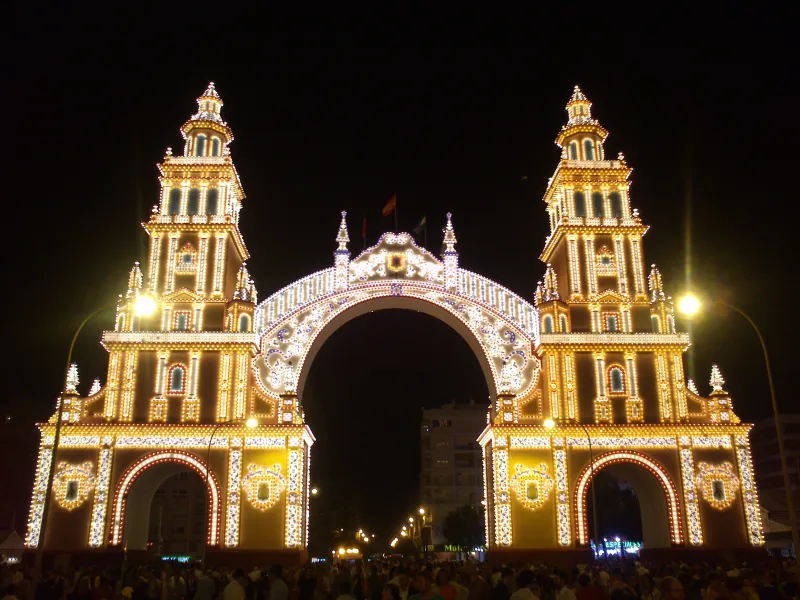
Feria de Abril Itinerary
How to plan days and nights at Seville's Feria de Abril: understanding the casetas and how to get inside one, what to wear, when the fairground comes alive, the daytime horse paseo, the rides, and how to fit ordinary sightseeing around the fair.
Read guide
Los Remedios Guide
A calm, residential grid across the river in southwest Seville: next door to the Feria fairground, walkable to Triana and the Guadalquivir, with everyday prices — and exactly when Los Remedios makes sense as a base.
Read guideMore in Events
6
Bienal de Flamenco Guide
How to plan a trip around Seville's Bienal de Flamenco, the world's most important flamenco festival: when it runs, the kinds of shows and venues, how to find and book tickets, where to stay, and what to do if your trip falls in an off year.
Read guide
Christmas in Seville Guide
Christmas in Seville means lights along the old streets, nativity scenes (belenes), traditional markets like the one in Plaza de San Francisco, festive shopping, sweets and family events — all in cool, comfortable sightseeing weather. How to enjoy the season and plan around it.
Read guide
Corpus Christi in Seville
A guide to one of Seville's most beautiful and least touristy traditions: the Corpus Christi morning, when the centre is strewn with fragrant herbs and a stately procession winds from the Cathedral through streets dressed for the feast. When it falls, what to expect, where to watch, and how to plan around the early-summer crowds.
Read guide
New Year's Eve in Seville
Nochevieja in Seville: the tradition of twelve grapes at midnight, where to gather, dinner timing, the late-night fiesta, taxis and getting home, and how to plan January 1. A practical guide to seeing in the year, Sevillano-style.
Read guide
Noche en Blanco Seville Guide
Seville's citywide cultural night, when museums, palaces, galleries and institutions open late and often free for one evening, usually in autumn. How it works, how to plan a route, what to reserve, and how to use it well.
Read guide
Semana Santa in Seville Guide
How to experience Seville's Holy Week with understanding and respect: what the processions are, where they pass, the great floats and brotherhoods, the all-night Madrugá, the crowds and street closures, what to wear and how to behave, where to stay, and how to plan a complex week calmly.
Read guide