
Accessible Seville Itinerary
A realistic, romantic accessible route through Seville built on smoother surfaces, level entrances, lifts, taxis and the tram — with honest notes on cobbles, ramps, rest stops and the heat, paced so the city stays a pleasure rather than an obstacle course.

Photo: Stefany Sá / Unsplash
- ✓Seville's flat old centre is one of the more accessible historic cities in Spain — but cobbles, narrow Santa Cruz lanes and uneven paving still need planning around.
- ✓This is a two-to-three-day shape, not a fixed timetable: see one big sight in the cool morning, rest through the heat, and keep evenings gentle.
- ✓The Real Alcázar, Cathedral, Plaza de España and María Luisa Park all offer step-free or assisted routes — but specifics change, so confirm each on the official site before you go.
- ✓Lean on the modern tram and accessible taxis between sights rather than forcing long stretches over rough surfaces.
- ✓In summer, the heat is the real accessibility barrier: shade, hydration and a midday pause matter more than distance.
Why Seville works — and where it doesn't
Seville is kinder to travellers with limited mobility than its tangle of medieval lanes might suggest. The historic core is genuinely flat — there are no hills to climb between the Cathedral, the Alcázar and the river — and the grand avenues laid out for the 1929 Exposition are broad and level. The headline monuments have spent the last two decades improving step-free access, the tram down the spine of the old town is low-floor and roll-on, and the city's compactness means you are rarely far from a taxi or a shaded bench. For many visitors, that combination makes a rich, romantic few days entirely possible.
The honest caveat is the ground itself. Parts of the old town — especially the lanes of Barrio Santa Cruz — are paved in rounded cobbles, slabs of polished stone that turn slick in rain, and pavements that narrow to nothing. Some beautiful corners involve a step at a doorway or a tight medieval alley with no level alternative. None of this makes Seville off-limits; it simply means the accessible plan is built around the smoother routes and the assisted entrances, accepting that a few picture-postcard lanes are best admired from their wider edges. This itinerary is shaped around what works, with the rough spots flagged honestly so you can decide for yourself.
- Flat core: no hills between the Cathedral, Alcázar, river and Plaza de España.
- Broad, level Exposition-era avenues to the south make easy, scenic distance.
- Watch for: rounded cobbles in Santa Cruz, polished stone in the rain, and the occasional doorstep at older entrances.
How to use this itinerary
Treat the days below as a shape to flex, not a schedule to chase. The single most important principle in Seville — for everyone, but doubly for anyone who tires more easily — is to front-load the day. Do the one big, demanding sight in the cool of the morning when energy and patience are highest and the crowds and heat are lowest, then ease off. The afternoon, especially from roughly May to October, is for resting somewhere cool: your hotel, a shaded park, a long lunch. The evening, when the city softens and the air turns kind, is for a gentle wander and a good dinner. That rhythm turns a potentially exhausting trip into a comfortable one.
Build in more slack than you think you need. Accessible travel always carries small frictions — a lift that's slow, a taxi that takes a few minutes to arrive, a detour around a stepped lane — and the antidote is simply not over-packing the day. One major sight plus one or two easy ones is plenty. Leave rest stops in deliberately, keep a list of accessible toilets and cafés as you go, and give yourself permission to cut anything that isn't working. Seville rewards slowness, and this plan is designed to let you enjoy the city rather than survive it.
- One demanding sight per morning; rest through the heat; gentle evenings.
- Over-budget your time — frictions are normal, so leave generous slack.
- Pre-plan rest stops, shade and accessible toilets rather than improvising while tired.

Day 1 — The UNESCO core, taken slowly
Begin with Seville's headline trio, which has the great advantage of clustering within a few level minutes of one another around the Avenida de la Constitución and Plaza del Triunfo — smooth, modern paving with the tram running alongside. Start at the Real Alcázar at opening, before the heat and the crowds. The palace has worked hard on access: there are step-free and assisted routes through much of the ground floor and into the gardens, with staff who can advise on the best way round. It is not uniformly flat — this is a thousand-year-old palace — so check the official accessibility information and ask at the entrance, but the core rooms and the glorious gardens are largely within reach.
From the Alcázar it's a short, level roll to the Cathedral and Giralda. The Cathedral interior is broad and mostly flat, with an accessible entrance, and the famous Giralda bell-tower is climbed by ramps rather than stairs — though the ramps are long, steep in places and not suitable for everyone, so treat the climb as optional and judge it honestly. The vast, cool nave makes a fine, restful sight even without the tower. If energy is fading, the Archivo de Indias next door is a calm, low-effort stop with handsome interiors. Then stop: that's a full, satisfying morning, and the afternoon is for rest.
Save the evening for the prettiest, easiest pleasure of all — a slow turn through the wider, flatter edges of Barrio Santa Cruz and the orange-tree squares around the Cathedral as the light goes gold. The deep interior of Santa Cruz is a maze of narrow cobbled lanes that's hard going on wheels, so don't force it; instead skirt its handsome perimeter, where the streets are broader and the surfaces kinder, and let the atmosphere come to you. Dinner at an accessible bar or restaurant nearby closes the day gently.
- Real Alcázar at opening — step-free and assisted routes exist; confirm specifics on the official site and ask staff.
- Cathedral interior is broad and flat; the Giralda is ramped but long and steep — optional, not essential.
- Evening: the broad, flatter edges of Santa Cruz and the Cathedral squares — skip the deep cobbled lanes.
Day 2 — Plaza de España and the green calm
The second day leans into Seville's most accessible-friendly quarter: the broad, flat, Exposition-era landscape to the south. The star is Plaza de España, and it is a gift for this kind of trip — a vast, mostly level tiled half-moon you can roll right into, with sweeping ramps, wide open space and a grandeur that needs no climbing. There are a few steps to some of the upper galleries and bridges, but the main plaza, the tiled province alcoves and the canal edge are all reachable on the flat, and the whole set piece is free and open-air. Come in the cooler morning for the light and the space, and give it time; it's one of the most rewarding easy sights in Spain.
Right beside it lies María Luisa Park, the single best move in any heat-aware Seville plan and especially friendly here: wide, largely flat, well-shaded paths wind between tiled fountains, ponds and quiet garden squares, so a stroll or roll under the canopy is comfortable even when the streets outside are baking. It's the perfect place to spend the warm middle of the day at a gentle pace, with benches and shade never far away. At the park's southern end, two museums in grand pavilions offer a cool, low-effort indoor anchor if you want one — check their access details and opening hours on the official sites, as both can vary.
Keep the rest of the day soft. The park and plaza together are a full, lovely outing, and the smart play is to let them be the day rather than rushing on. If you have energy left in the evening, the riverfront near the Torre del Oro has long, flat, paved promenades made for an easy sunset wander, with the water on one side and the old town on the other — a romantic close that asks almost nothing of tired legs.
- Plaza de España: roll-in ramps and a flat main plaza — free, grand and genuinely accessible (upper galleries have steps).
- María Luisa Park: wide, shaded, mostly flat paths — the ideal place to pass the midday heat slowly.
- Optional evening: the flat riverside promenade by the Torre del Oro for an easy sunset.
Day 3 — Triana, the river and a flexible flourish
With the essentials covered, a third day is for character and choice. Crossing the Guadalquivir to Triana works well on the flat, scenic riverside promenades and the bridges, and the neighbourhood rewards a gentle potter: the covered Mercado de Triana is a level, atmospheric place to graze, the ceramics tradition is on show along the main streets, and Calle Betis gives you river terraces with a view back to the old town. As ever, the deeper Triana lanes can be cobbled and uneven, so stick to the main thoroughfares and the waterfront, which are the easiest going.
Alternatively, use the third day to revisit a favourite at an even slower pace, to take in a rainy-day indoor sight, or to simply rest and enjoy long tapas and people-watching. If a flamenco evening appeals, several tablaos and the flamenco museum are reachable; check the specific venue's access (some are in historic buildings with steps) before booking, and choose one that suits. There is no obligation to cram — a third day used for breathing room is a third day well spent, and it keeps the whole trip on the right side of enjoyable.
However you shape it, end on the river at dusk. A flat promenade, the bridges lit, the Torre del Oro glowing and the old town's silhouette across the water make for a finale that is pure Seville and asks nothing of anyone — the kind of slow, golden moment this whole itinerary is built to protect.
- Triana via the flat riverside and bridges — Mercado de Triana and Calle Betis are the easy, rewarding stops.
- Or spend the day resting, revisiting a favourite, or taking an indoor sight at a gentle pace.
- Check individual flamenco venues for steps and access before booking an evening show.
Getting around: tram, taxi and the surfaces in between
Distances in central Seville are short, but the surface underfoot varies enormously, so the smart accessible strategy is to use mechanised transport between sights and walk or roll only the smooth, level stretches. The modern tram (the Metrocentro line) runs along the heart of the old town between the San Bernardo and Plaza Nueva ends, passing the Cathedral, and its low-floor vehicles and level platforms make it the easiest single link in the centre. Accessible taxis are available too, and given the compactness of the city, a short taxi between, say, your hotel and Plaza de España is often the kindest choice on a hot or tired day. Pre-booking an accessible taxi is wise; ask your hotel to help.
The single underground Metro line is fully accessible with lifts but mostly serves the outskirts rather than the tourist core, so it's useful chiefly if you're staying further out. City buses are increasingly low-floor and ramped, though they can be busy. The thread running through all of it: don't try to power across the old town on foot when a tram or taxi will spare you the cobbles. Plan your hops, keep some flexibility, and treat transport as part of the comfort of the trip rather than an afterthought. Exact routes, fares and accessible-taxi arrangements can change, so confirm the current details locally.
- Tram (Metrocentro): low-floor, level boarding, runs through the old-town core past the Cathedral — the easiest central link.
- Accessible taxis: available and worth pre-booking; short hops spare you the worst surfaces.
- Metro: fully accessible with lifts, but mainly serves the outskirts; buses are increasingly ramped.
- Verify current routes, fares and accessible-taxi booking locally — these details change.
Before you book: the preparation that makes it work
Accessible travel in Seville rewards homework done in advance, and a little of it transforms the trip. Start with the base: choosing a hotel in the flat heart of the centre — within easy reach of the Cathedral, the tram and a taxi rank — shrinks the hardest part of every day, the getting-to-and-from. Look for genuinely step-free entrances and lifts (not just a 'ground-floor room' beside a flight of steps at the door), and ask the property directly about doorway widths, bathroom layout and whether the surrounding streets are paved or cobbled. Many beautiful Seville hotels occupy historic buildings with charming but tricky thresholds, so confirm the specifics rather than assuming.
Then sort the sights you most want to see, one at a time. Each major monument publishes its own accessibility information, and the details — which routes are step-free, where the lifts are, whether a companion goes free, how to request assistance — are exactly the things that change and that a guidebook can't promise. Read the official page, and where a sight invites you to arrange assistance ahead, do it; staff are far more able to help when they're expecting you. Build a short list of accessible cafés and toilets near your route as you research, and you'll spend the trip relaxed rather than hunting. The single biggest predictor of a smooth accessible Seville is simply that you confirmed the variable details before you left home.
- Pick a flat, central base with a genuinely step-free entrance and lift — confirm doorway and bathroom specifics with the hotel.
- Read each major sight's official accessibility page and arrange any assistance in advance.
- Pre-scout accessible cafés and toilets along your route so you're never caught out while tired.

Pacing, energy and the art of cutting plans
The most common mistake on any Seville trip — and the costliest for travellers managing limited energy — is trying to do too much. The city packs so many treasures into so small a space that it's tempting to chain them together, but distance over cobbles, queuing, heat and the sheer stimulation of it all drain reserves faster than the map suggests. The antidote is to plan fewer things and protect them. One major sight a day, done well and at leisure, beats three rushed and exhausting ones, and you'll remember the unhurried morning in the Alcázar gardens long after you've forgotten whatever you crammed in afterwards.
Give yourself explicit permission to stop. Build rest into the plan as a fixed feature, not a fallback — a long, shaded lunch, an afternoon back at the hotel, a bench by a fountain whenever one calls. Carry whatever helps you conserve energy, whether that's a lightweight folding stool, a power chair charged the night before, or simply a willingness to take the taxi instead of pushing the last few hundred metres. And when something isn't working — a lane too rough, a queue too long, a day too hot — let it go without guilt. Seville is generous; it will still be glorious if you see half of what you planned at a pace that leaves you smiling.
It helps, too, to think of the trip in terms of energy budgets rather than checklists. Front-load the demanding activity into the freshest part of the day, leave the low-effort pleasures — a park bench, a riverside coffee, a long meal — for when reserves run low, and keep one easy fallback in your pocket for any day that goes sideways. Travelling with a companion, share the planning and the load openly; travelling alone, lean a little more on taxis and central bases to keep the margins comfortable. None of this dilutes the romance of the place. If anything, the slow, deliberate version of Seville is the truest one.
- Plan fewer things and protect them — one great sight a day beats three rushed ones.
- Schedule rest as a fixed feature: long lunches, hotel breaks, benches by fountains.
- Cut anything that isn't working — rough lanes, long queues, hot days — without guilt.
- Think in energy budgets: demanding things early, easy pleasures for when reserves run low.

What to pack and carry for an easier trip
A few deliberate choices in the bag smooth out a great deal. Comfortable, well-cushioned footwear matters more here than almost anywhere, because even the smooth routes involve time on your feet and the cobbled stretches reward shoes that grip and support. In the warm months, sun cover is non-negotiable — a hat, sunglasses, high-factor sunscreen — alongside a refillable water bottle you keep topped up, because steady hydration is the simplest defence against the heat that, more than any cobble, limits an accessible day. A small portable charger keeps your phone alive for maps, tickets and a taxi app when you need them most.
If you use a wheelchair or mobility aid, a basic repair kit, a spare set of whatever your equipment depends on, and a charged spare battery for a power chair are worth the space — Seville has the services to help, but a minor fix shouldn't derail an afternoon. Keep copies of any essential medical information and your accommodation details to hand, carry a little cash for the smallest bars and for tipping a helpful taxi driver, and pack a light layer even in summer for cool evenings and fierce air-conditioning. None of this is heavy or complicated; it's just the quiet preparation that lets you focus on the city rather than the logistics.
- Supportive, cushioned shoes for the cobbles and the miles; a light layer for cool evenings and strong AC.
- Sun cover and a refillable water bottle — hydration is the real heat defence.
- Portable charger for maps, tickets and taxi apps; a little cash for small bars and tips.
- Mobility-aid users: a basic repair kit, key spares and a charged spare battery for a power chair.

The heat is an accessibility issue
It's worth saying plainly: in a Seville summer, the heat is often a bigger barrier than any cobble. From June to September the afternoons are genuinely punishing, and heat hits hardest exactly the travellers who already manage limited energy, certain medications or conditions affected by high temperatures. The whole shape of this itinerary — big sight early, long pause through the worst of the afternoon, gentle evening — exists primarily to keep you out of the danger hours. Don't treat the midday rest as optional in high summer; treat it as the plan.
The practical defences are simple and they matter. Carry water and drink it before you're thirsty; favour the shaded, canopied routes like María Luisa Park and the tree-lined avenues; wear sun cover and a hat; and keep cool indoor or shaded boltholes in mind everywhere you go. If you have any heat-sensitive condition, build the day around air-conditioned and shaded spaces and don't be shy about cutting plans. For the most comfortable trip overall, the spring and autumn shoulder seasons are far easier than peak summer — something worth weighing when you choose your dates.
- Summer afternoons are the real barrier — the early-and-evening rhythm is a safety measure, not just a preference.
- Water, shade, sun cover and known cool boltholes; drink before you're thirsty.
- If heat-sensitive, consider spring or autumn instead of July–August for a far easier trip.

At a glance
A quick planning summary. Access details at individual sights and the specifics of accessible transport do change over time, so use this as a frame and confirm the current details — especially step-free routes, lifts and accessible-toilet locations — on each official site before you rely on them.
- Shape: 2–3 days; one major sight each cool morning, rest through the heat, gentle evenings.
- Easiest sights: Plaza de España (roll-in, flat main plaza), María Luisa Park (shaded, flat), the Cathedral nave, the flat riverside promenades.
- Plan carefully: Real Alcázar (assisted routes; confirm), the Giralda (ramped but long/steep — optional), deep Santa Cruz and Triana lanes (cobbled — skirt the edges).
- Transport: tram and accessible taxis for hops; walk only the smooth, level stretches.
- Always verify locally: step-free routes, lifts, accessible toilets, tram/taxi specifics, and museum hours.
A romantic, unhurried Seville
The reassuring truth is that the most romantic version of Seville and the most accessible version are almost the same trip. Both ask you to slow down: to take the gardens at opening, to let an afternoon dissolve in the shade, to save the river and the lit monuments for the soft evening hours. The grand, level set pieces — Plaza de España, the Alcázar gardens, the canopy of María Luisa Park, the glowing riverfront — are precisely the places that work best on wheels and the places that make people fall for the city. You lose very little by planning carefully, and you gain a trip paced to be enjoyed.
So plan around the smoother routes and the assisted entrances, build in the rest, lean on the tram and the taxi, and let the rough lanes go without regret. Confirm the access details that matter to you in advance, keep your days generous and flexible, and Seville will give you its best self — golden, gracious and entirely worth the journey.

Accessible Seville Travel Guide
A realistic, affectionate guide to seeing Seville with limited mobility, a wheelchair or a slower pace — which monuments roll well, where the cobbles bite, how the taxis and tram help, and how to build heat breaks into a day so the city stays a pleasure rather than a battle.
Read guide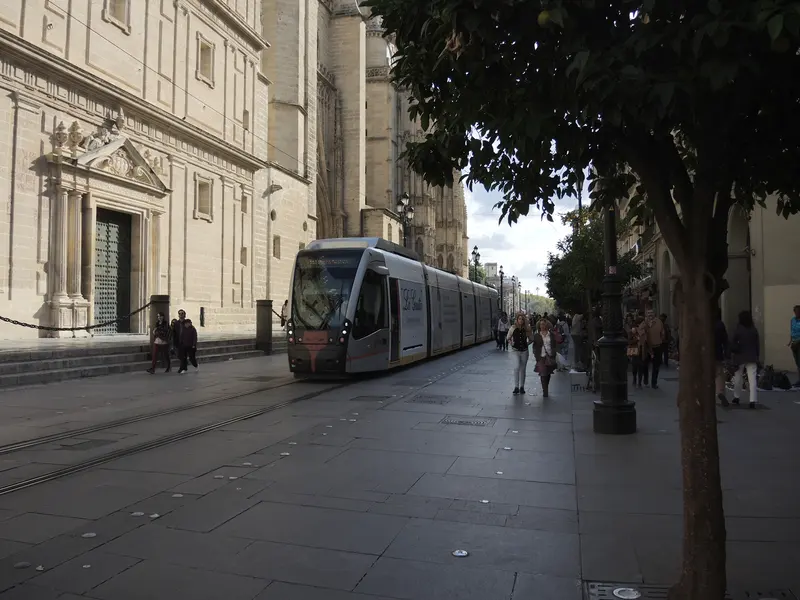
Seville Public Transport Guide
Buses, the tram, the single metro line, the airport bus and taxis explained — how Seville's transport fits together, when each is worth it, and the honest truth that in the old centre you'll mostly just walk.
Read guide
María Luisa Park Guide
Shaded walks, tiled fountains, hidden plazas, picnic stops and museums in María Luisa Park — the green heart of Seville, and the easiest place to escape the heat right beside Plaza de España.
Read guideMore in Itineraries
6
2 Days in Seville Itinerary
A balanced two-day Seville plan: the UNESCO icons and Plaza de España on day one; Triana, the Setas, a market and a flamenco night on day two — built around the ticket slots and the afternoon heat.
Read guide
3 Days in Seville Itinerary
A complete three-day Seville itinerary: the UNESCO icons and Plaza de España; Triana, the Setas and flamenco; then a quieter palace, a market morning, a museum and slow golden-hour river time.
Read guide
4 Days in Seville Itinerary
A four-day Seville itinerary: the icons, Triana and flamenco, a quieter palace and a museum — then a fourth day for one Andalusian day trip, Córdoba's Mezquita above all, or a deliberate day off.
Read guide
Feria de Abril Itinerary
How to plan days and nights at Seville's Feria de Abril: understanding the casetas and how to get inside one, what to wear, when the fairground comes alive, the daytime horse paseo, the rides, and how to fit ordinary sightseeing around the fair.
Read guide
Heat-Smart Summer Seville Itinerary
How to actually enjoy Seville in summer: a day built around early starts, a long midday break, pools and shade in the worst hours, and the long warm evenings the city was made for — with a sample three-day plan.
Read guide
Luxury Weekend in Seville
A high-end two-day Seville plan — palace hotels, private guides for the Alcázar and cathedral, rooftop sunsets, spa afternoons, fine dining and a flamenco night, all at an unhurried pace.
Read guide